
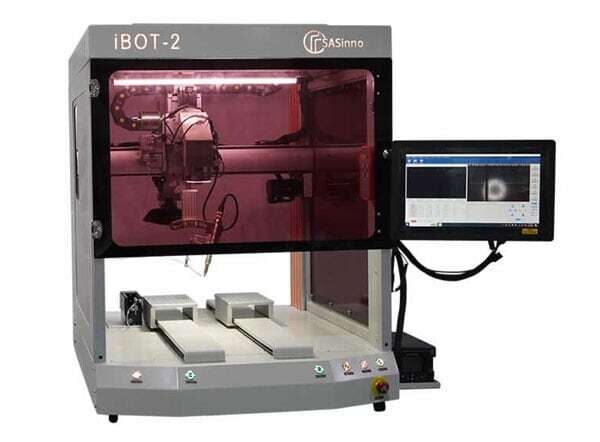


iBot-2 Questions and Answers
How does the iBot-2 dual-table configuration double productivity?
The machine is always soldering — unloading/loading occurs simultaneously with active soldering on the alternate table.
What are the machine travel dimensions for the iBot-2?
X: 215mm (per section); Y1/Y2: 420mm independent; Z: 80mm; R: 320° . Weight is ~170 kg.
What is the repeat positioning accuracy of the iBot-2?
±0.05mm — the dual-table setup does not compromise precision.
What environmental and installation requirements apply to the iBot-2?
Air: 0.4–5 kg/cm²; Load: 5 kg; Size: 834mm × 853mm . It fits in nearly the same floor space as the iBot-1.
What iBot-2 solder wire specifications and tip options are available?
Identical to iBot-1: 0.8–1.2mm standard wire, JBC R470 tips, and automatic tip cleaning .
What is the fundamental difference between the iBot-1 and iBot-2?
The iBot-2 adds a second independent Y axis for dual separate working zones. While soldering on one table, the operator loads/unloads the other, eliminating idle time.
When should I choose the iBot-2 over two separate iBot-1 units?
When handling is the bottleneck and floor space is constrained . iBot-2 is more cost-effective when one operator manages the machine.
What is the ROI advantage of the iBot-2 over the iBot-1?
It delivers nearly 2× throughput for a smaller capital increment, making the cost per joint soldered nearly half.
Does the iBot-2 use the same JBC soldering station as the iBot-1?
Yes. Performance, quality, and tip compatibility (JBC R470 type) are identical.
Is the iBot-2 CCD path teaching system the same as on the iBot-1?
Yes. It identifies markers and enables ~10-minute setup. Programs can be transferred with axis mapping adjustments.